
“The fire in Mati cannot but have left the most indelible marks on our souls, and especially on the souls of those who experienced the tragedy firsthand,”, stresses Volunteer Fire Sergeant Pavlos Kokkos.

In Greece, which is plagued by devastating fires every summer, with the climate crisis exacerbating the situation, making it more difficult to extinguish fires and prolonging the fire season, there is a silent, unwavering force that, while standing on the front line, remains in the shadows. They are the volunteer firefighters. These are citizens of all ages and professions who decide to selflessly offer their time, strength, and sometimes even their lives to protect human life, natural resources and property.
Indicative of the grim reality are the numbers: more than 2,800,000 acres were burned in just 10 fires that broke out in Greece over a period of 20 years, specifically from 2003 to 2022, while in the Attica region alone, 37% of forests has burned from 2017 to 2024. Τhe deadly fire in Mati on July 23rd 2018 is a tragic anniversary- reminding us how vulnerable we are towards a natural phenomenon that keeps worsening.

Pavlos Kokkos: The willingness to selflessly offer has neither age nor profession barriers.
And yet, in the midst of this burning hell, another flame continues to be distinct; that of selfless offer, solidarity and volunteerism. Pavlos Kokkos, Volunteer Fire Sergeant, Vice President of the Hellenic Volunteer Firefighters Association, and Deputy Commander of the Hydra Volunteer Fire Substation, spoke to “Kyriakatiki Apogevmatini” about this particular “body” of people who are driven by the desire to help their fellow human beings.
The Hellenic Volunteer Firefighters Association is the official representative for approximately 5,000 Greek volunteer firefighters who currently serve in the fire department, to which they belong.
“The willingness to serve is not limited to age groups nor specific professions. It is a matter of culture, a way of life,” emphasizes Mr. Kokkos, who goes on to explain how someone can become a volunteer firefighter.
In order to become a volunteer firefighter, one must be between 18 and 55 years old, be in good mental and physical health, be a Greek citizen or a citizen of the European Union who has been permanently residing in Greece for the last five years, and have an excellent command of Greek reading and writing. Every year from the beginning of July until the end of September, they can submit the relevant application with the required supporting documents to their nearest Fire Department, and then attend a certified 120-hour theoretical and practical training program. This training program is organized by the Hellenic Fire Academy and conducted by the Fire Department at the facilities of the Fire Services throughout the country.
Candidates then take part in written and practical exams and, if successful, acquire the status of Volunteer Firefighter, are registered in the Fire Department’s Volunteer Firefighters register, assigned to the Fire Station (career or volunteer) where they submitted their initial application, and begin to perform their shifts normally, alongside career firefighters as well as other volunteer firefighters. It should be noted that in order to maintain the status of the Volunteer Firefighter, one must do at least three eight-hour shifts per month, i.e. a total of thirty-six per year.
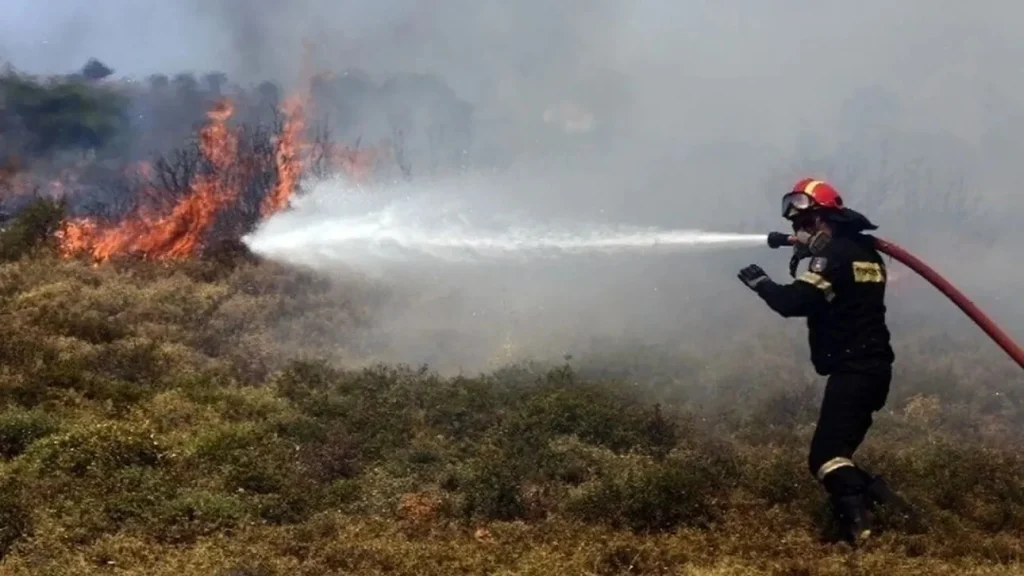
From Mati to Evros
It is important to stress that volunteer firefighters, who are fully integrated into the operational planning of the Hellenic Fire Service, respond to every incident that occurs during their eight-hour shift. As such, members of the Hellenic Volunteer Firefighters Association have responded to all major fires that have occurred since the institution was established. The most notable ones, of course, were the fires in Mati in 2018, in Attica in 2021, 2022, 2023, and 2024, in Evros and Euboea in 2023, as well as a number of other smaller or larger fires. Of course, the fire in Mati cannot but have left the most indelible marks on our souls, and especially on the souls of those who experienced the tragedy firsthand,” emphasizes Mr. Kokkos.
The harsh reality for volunteer firefighters
However, behind the heroism lies a harsh reality. Unfortunately, volunteering, and specifically volunteer firefighting in Greece, as Mr. Kokkos points out, still has a long way to go in order to catch up with other European Union countries and the rest of the developed world.
“For some incomprehensible reason, the Greek state hasn’t been able to follow European and international practices in the field of volunteering, which date back more than 150 years. As Hellenic Volunteer Firefighters Association, we are often forced to strive for the obvious and for things that had been resolved in other countries many years ago. You can see how this slows down progress and often wears down volunteer firefighters, who end up feeling discouraged and putting aside any desire to help because of this situation. Of course, in recent years, due to the climate crisis, both the political and the physical fire and civil protection leadership have become more aware of the need to invest in Greek volunteer firefighters, which gives us a note of optimism and courage to continue our struggle to improve the institution. However, this is happening in small, tentative steps. At this point, I would like to emphasize that the legislative framework governing volunteer firefighters may have been established in 1991, but it was essentially specialized in 2011. Since then, however, it has undergone minimal changes for update and modernization.
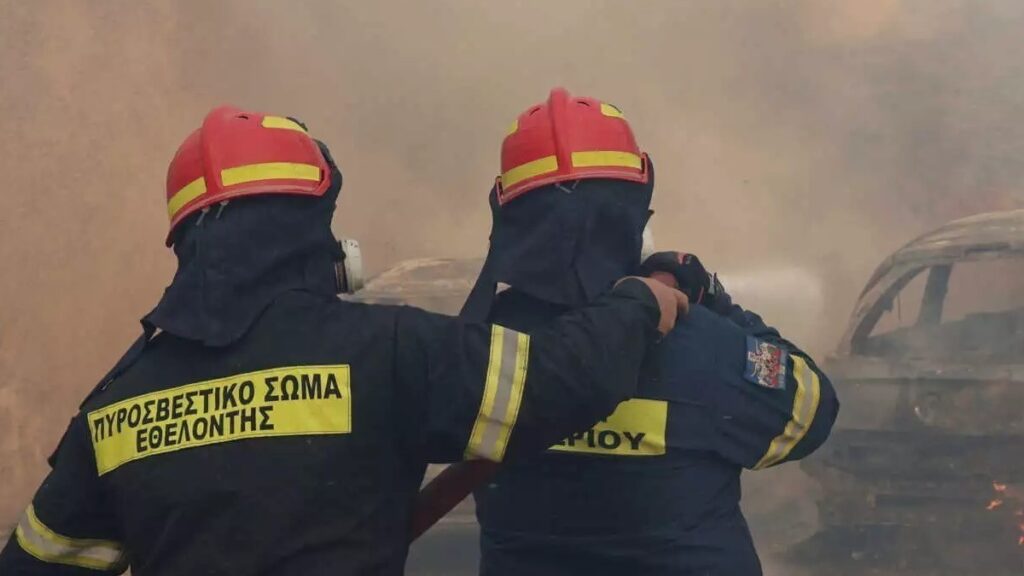
This contrasts with the legislative framework for other firefighters, which underwent radical reform in 2020. It has to be taken into consideration that until 2020 and before the large donation by the Stavros Niarchos Foundation to the Hellenic Fire Service, we did not even receive basic clothing. Then, thanks to this donation and after a long struggle on our part, as well as the practical and decisive support of the then President of the Hellenic Republic, Mr. Prokopis Pavlopoulos, we managed to ensure that Personal Protective Equipment (PPE) be provided from this donation for all 3,500 active Volunteer Firefighters at the time. So, you can understand that until then, each colleague either had to “beg” for PPE from older colleagues or purchase it themselves. The cost of a complete set of personal protective equipment, at current prices, is around €2,000”.
Lack of volunteering mentality and culture
And the question that reasonably arises is why are we so far from developing a culture in volunteering? “The main reason is the belief held by most people in our country that whatever you do, you should receive some financial compensation. However, this belief is completely wrong, considering that in most developed and developing countries around the world, volunteer firefighters constitute the main force in terms of numbers in the field of firefighting and rescue. A typical example is Germany, which now has more than 1,000,000 volunteer firefighters, as opposed to a few tens of thousands of career firefighters. In other words, 98% of active firefighters are volunteers. Austria also has around 250,000 volunteer firefighters and approximately 2,500 career firefighters. Japan has 750,000 volunteers and 150,000 career ones. In Slovenia, with a population of 2 million, there are 550 career firefighters in 14 professional stations and 60,000 volunteer firefighters in 1,293 volunteer fire stations. And if I continue, you will see that the same picture prevails in most countries. Therefore, what needs to change, in my opinion and that of the Hellenic Volunteer Firefighters Association, in general, is the way in which the term Civil Protection is understood by the State itself and its officials, but also, by extension, by the citizens of this country. In short, we must all understand that protecting life and the environment is the responsibility of both the State and each one of us,” says Mr. Kokkos.
“What motivates volunteer firefighters is their innate concern for their fellow human beings, nature, and the world and its development in general. Personally, I cannot imagine someone in need and just walking past them, not helping them. Nor can I imagine something bad happening in my area and not rushing to help. It’s a way of life, you know. The adrenaline that is secreted in times of emergency gives us such intense feelings that it really strengthens us and motivates us to give our best to help prevent anything harmful. It’s a feeling that, unless you experience it, you can’t fully understand,” he adds.
In any case, at a time when crises follow one another and nature is sending out danger signals, volunteering is not a luxury, it is a necessity. So, let’s take the next step. Let’s see volunteer firefighters not only as heroes of the forests and flames, but as a reflection of our own social responsibility. The state must support them institutionally, substantively, and over time. And we, the citizens, should rethink what we can offer, not just what we will gain. Because the flame of offer is the only one that must not be extinguished.
27.07.25 Kyriakatiki Apogevmatini


